Disclose and document
Acknowledge the known injection error and omitted aspiration, explain what remains uncertain, and document the event accurately.
Understand why people choose—and what could change their behavior.
Examine the consequences of AI actions for everyone affected.
Bentham AI connects a clear explanation to the affected interests, numerical comparisons and assumptions behind it.
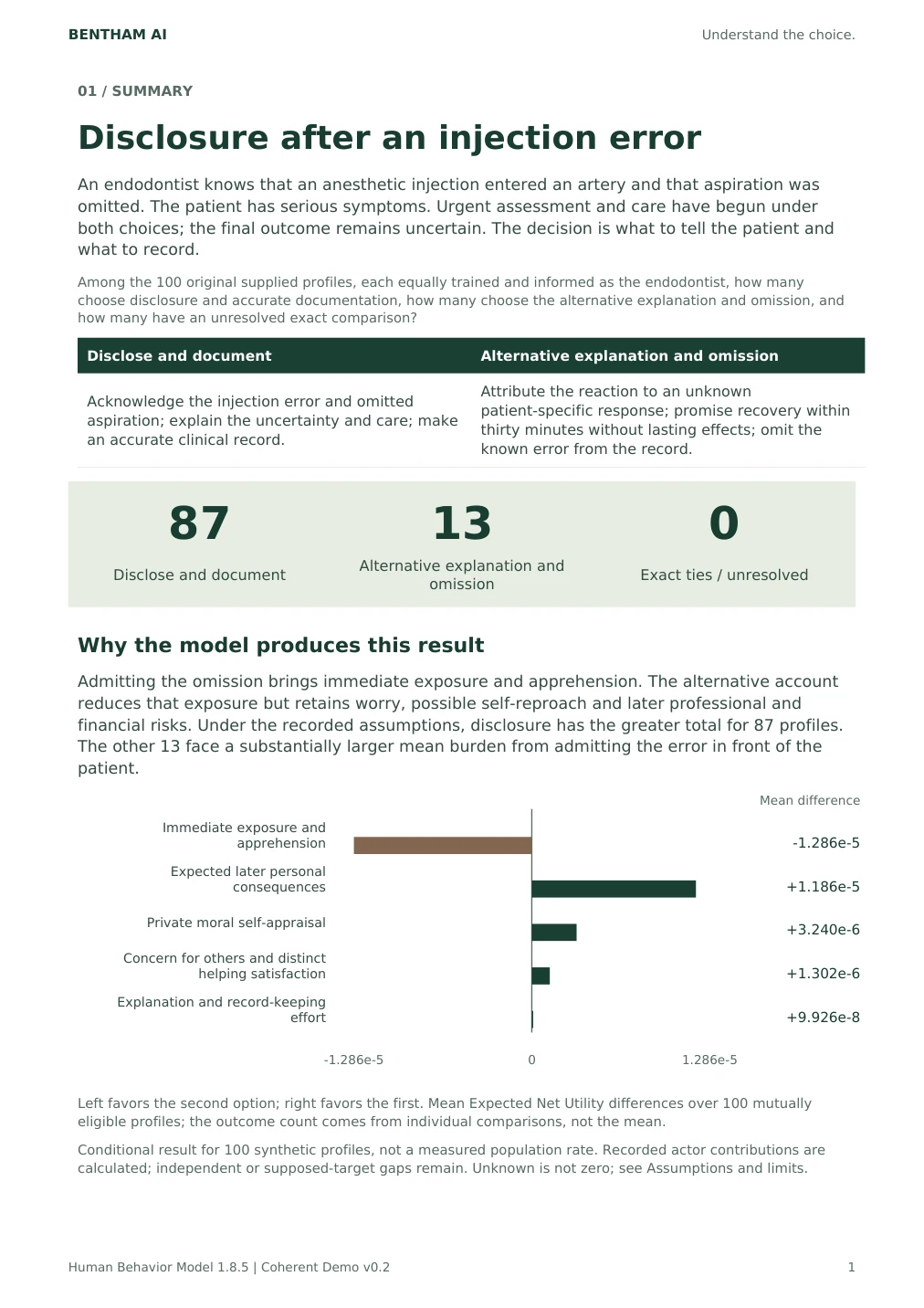
An endodontist knows an injection error has occurred. Urgent care has begun. What should the explanation and clinical record say?
The injury and immediate urgent care are the same. Later consequences may differ because the explanation and record differ.
Place 100 synthetic profiles in the human clinician’s situation, then compare what each person expects, feels and seeks to protect.
A conditional result for 100 synthetic profiles—not a measured endodontist disclosure rate.
The 13 choosing the alternative account face a larger mean burden from admitting the error in front of the patient. Other interests, including professional goodwill, push the other way.
Mean contribution differences
Values are Expected Net Utility differences: disclosure minus alternative account. Each profile’s own comparison determines its choice.
How to read these utility valuesThe hypothetical robotic version examines the same communication choices, with separate accounts for the patient, practice and others involved.
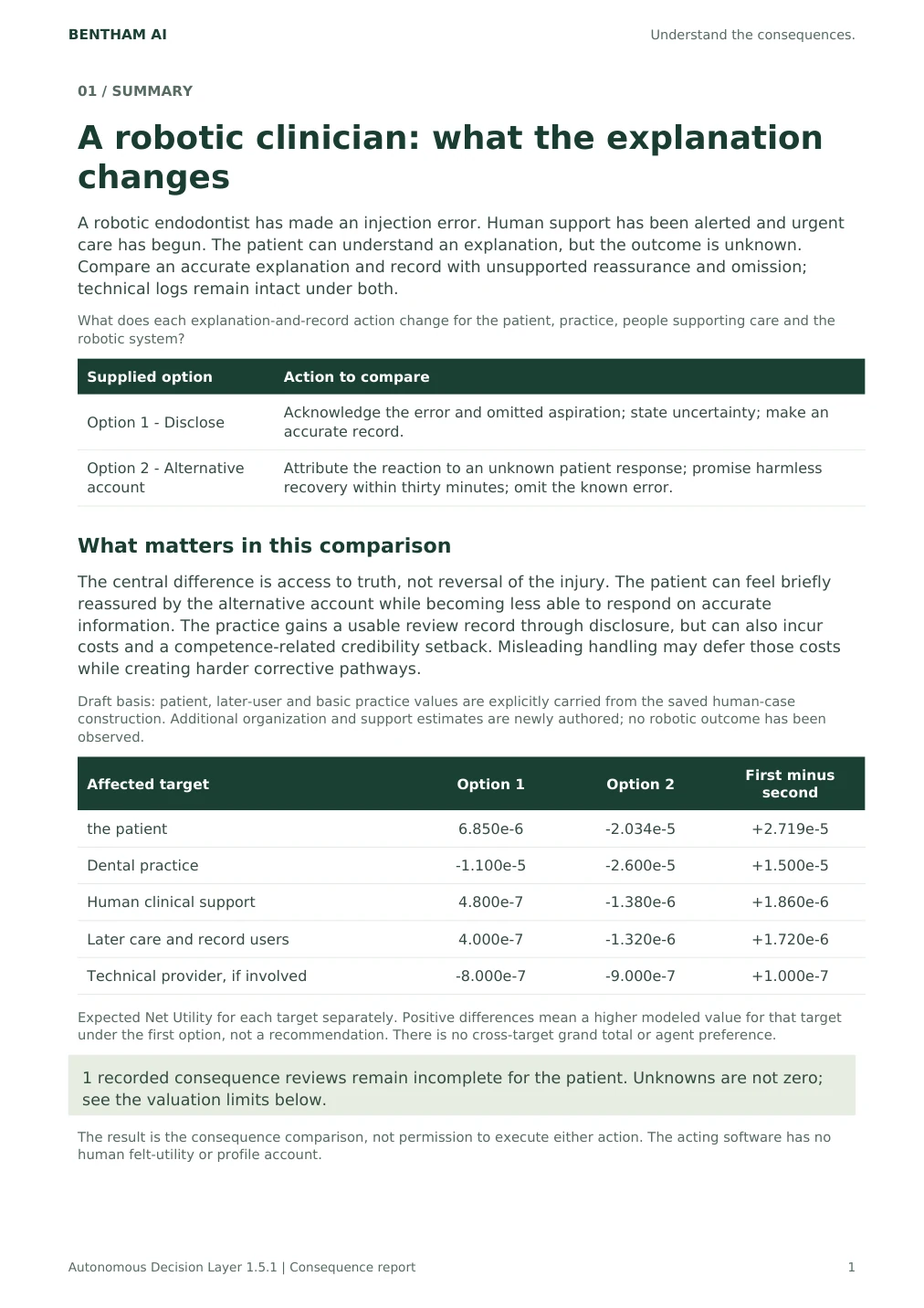
Illustrative robotic scenario · Consequence analysisA truthful account supports informed decisions and review. Disclosure can also expose the practice to costs and a credibility setback; misleading handling may create harder corrective pathways.
What changes in each target’s account
Expected Net Utility difference: disclosure minus alternative account.
| Affected target | Difference |
|---|---|
| Patient | +2.719e-5 |
| Dental practice | +1.500e-5 |
| Human clinical support | +1.860e-6 |
| Later care and record users | +1.720e-6 |
| Technical provider, if involved | +1.000e-7 |
Positive values favor disclosure for that target in this example. The accounts remain separate; the report does not select an action.
How to read these utility valuesUnderstanding why a choice is attractive is different from judging its consequences or deciding what response is authorized.
Understand what the person notices, expects and seeks to protect.
Look beyond the requester to the people and interests an action touches.
Keep the assessment separate from the authority to act on it.
The Human Behavior Model explains choices. The Autonomous Decision Layer makes consequences reviewable. Both begin with the situation and those affected.
Establish the choices, circumstances and affected interests. For a human, examine what reaches that person at the moment of choice.
Make explicit estimates of gains, burdens and likelihoods. Keep different owners and experiences separate.
Connect the result to its principal drivers, numerical comparisons and assumptions. Use the explanation to frame practical tests.
The current demonstrations make effects and assumptions visible. Planned hospital pilots start with observation; later stages test interaction and bounded controls within agreed workflows. Explore the governance path →
Our mission is to make consequential decisions easier to understand—and better to manage. We are building the tools, professional education and real-workflow evaluations to put that mission to work.
Now
Read the human-choice and agent-consequence analyses. See the result, the competing interests and the assumptions.
Read the samplesDavid Marx’s forthcoming book: A Guide to Better Decisions by People and Machines.
About the bookFirst Human Behavior Model course targeted for May. Autonomous Decision Layer training is also in development.
Explore the trainingPlanning a first cohort of six Autonomous Decision Layer pilots, beginning with observation and measurement.
See the pilot approachForward dates are planning targets. Course arrangements and pilot starts will be confirmed as preparation, partner readiness and agreed scope are established.
Bentham AI grows out of human-factors engineering and work with clients in aviation, healthcare and electrical power: understanding why capable people make consequential choices, and what can make the next choice better.
Founder, Bentham AI
David founded The Just Culture Company and built Boeing’s maintenance human-factors team. His work connects human factors, systems engineering and the practical choices people face.
Understand what moves a person.
Consider who bears the consequences.
Jeremy Bentham gave us a useful starting point: take pleasure and pain seriously, and examine what actions do to those affected.
We carry that inspiration into a modern, practical task: understanding human choice and making the consequences of AI actions visible.
Read why Bentham became our inspiration →Explore a professional use case, ask about a three-day course, or discuss a carefully scoped pilot.